Please Read This First

The Honourable Company of Horners has created this Supplementary Blog to enhance the HCH's regular website. We will use this Blog to give you information that does not easily fit within the structure of the other website.
If you would like to highlight an event or item, please send the information and images to: HCHwebmaster@jwwebsolutions.com.
Always check www.HornGuild.org for additions by clicking on the tab just above.

The Clash of the Titans is Finally Here!

This “reprint” is for those who have not been following the news of the upcoming Clash of the Titans through the HCH’s publication, The Horn Book. The three articles are presented below in chronological order, so you can appreciate the suspense and intrigue of this contest.  You will notice the date “smack down” has changed, but it is here and it is final. We will be reporting of the outcome! -Bill Carter JM

Roland Cadle, Founder and Master Horner.

Billy Griner, Freeman and Past Guildmaster.

Clash of the Titans to Occur March 4-5, 2011  at the HCH Annual Meeting! (now at Dixon’s 2011) From the December 2010 Issue of The Horn Book

The investigative department of The Horn Book uncovered a major conflict within the Guild and we thought it only appropriate to keep the membership informed. Rumor has it that Billy Griner mentioned to Roland Cadle that he had the prettiest little green horn and was going to make a North Carolina Banded Horn with it.  Roland responded that he too had a nice little horn and he was going to make one as well and that his would be more historically accurate down to the most minute detail.  Billy responded that he doubted that anyone who has hardly ever left the great state of Pennsylvania could even begin to understand basic southern colonial culture that inspired such a “unique accoutrement!” -Whoa!!!  The gauntlet has been thrown down; it’s Roland Cadle (160 lbs) vs Billy Griner (275 lbs) in the great North Carolina Banded Horn smack-down to take place March 4-5, 2011, at the Guild’s Annual Meeting! -Each is to bring their completed banded horns for judgment.  Guild members in attendance can cast their vote at the registration desk as to which horn they like best, with the winner being announced at Saturday night’s supper. A benefactor, who wishes to remain anonymous, has offered a $100 prize to be awarded to the winner with the stipulation that should a tie occur, the winner will be determined by the Guildmaster – wait, he’s from Pennsylvania so that’s not fair!  OK, the Awards Committee Chief – he’s from Pennsylvania too!  OK then the Treasurer – Pennsylvania again!  How about the Secretary – ditto!  Hell, just pick one! As I see it, Billy has three problems: #1- too many tie breaking judges from Pennsylvania, #2- his opponent is a preacher man, and #3- everyone can’t help but look at this event as a David vs Goliath moment!!  And Billy ain’t David!! This is one annual meeting I don’t want to miss; it should prove quite interesting, as with the personalities involved, it shall indeed be a battle of biblical proportions! Expect to see a full blown article on this clash of egos in the January 2011 issue of The Horn Book!

Battle of the Titans From the Winter 2011 Issue of The Horn Book

It is with great sadness, but my duty, to report that the greatly anticipated Battle of the Titans (aka Roland Cadle vs Billy Griner) has been postponed till Dixon ’s.  Why are these two gladiators disappointing the crowds who planned on gathering in the coliseum to witness this clash of warriors!  The much anticipated Smackdown of Smackdowns has turned out to be a Naptime of Naptimes!  A real yawner!  But fear not, this intrepid reporter will stay on the story and keep you posted and up to date on all the behind the scene maneuverings.  Not only will another follow-up story appear in the May issue, but there are already a few tidbits of information you need to be made aware of regarding recent developments of this ongoing saga!  I embellish, …er report, you decide!

-Last October four Guild members (Billy Griner, Rick Sheets, Jeff Bottiger and Ed McDilda) attended an event at the Museum of Appalachia in Norris , TN to demonstrate and promote horn work.  All was fine till Ed started asking Billy a lot of questions about the design and architecture of his horn that would be competing against Roland’s.  After 3 days Billy got suspicious when he found out that Ed was from Pennsylvania , just like Roland.  So is it true that Roland sent a spy to Tennessee with specific instructions to gain information from Billy on his horn?  Why did Ed McDilda undertake such a dangerous mission?  When the two were contacted, Roland said this whole episode was a figment of Griner’s imagination and Ed said, “What’s a figment?”

-Is it true that Billy threatened this reporter with bodily harm if an immediate cessation of verbiage didn’t occur?

-Is it true that Billy wants to square off with Bowie Knives and a Silk Scarf to work this whole “banded horn” thing out?

-And finally, is it true that Bill Scurlock, Publisher of Muzzleloader Magazine has doubled the prize money to be awarded, bringing the total to $250!!

STAY TUNED!  MORE TO FOLLOW!

Clash of the Titans From the Summer 2011 Issue of The Horn Book

–Update: Suspense, intrigue, illicit spying, verbal sparing, threats, hints of violent acts, confrontations postponed, media meddling, mysterious benefactors feeding the frenzy with promises of monetary gain! – Yes Guild members, this is what it has all boiled down to.  No Guild members I am not talking about the sorry state of affairs in our nation’s capital, I’m talking about the “Smackdown of Smackdowns,” the “David vs Goliath,” the “Northern Confederacy vs the Southern Cabal” or the more popular description – the “CLASH OF THE TITANS!!” Yes Guild members, the time has come to poney up, belly up to the bar, put up or shut up, show me the money, and walk the walk.  In just a few weeks this saga of sagas will enter its final phase!  Will the rhetoric exceed the artisanship?  Will the light shine down on the “Preacher Man?” Will he have to summon help from on high?  Will the “Pride of the Southern Colonies” land a knockout punch?  Will it once again take Southern stamina, fortitude, dedication and perseverance to show northern colonialists how to finish a fight they started, as occurred back in the Revolutionary War? These and other questions will finally be put to rest during the Guild’s summer gathering at Dixon ’s.  Specifically, on Friday evening at the Jacobsburg Historical Society when the Guild has its annual summer cookout, the “Feasts of Feasts!” All Guild members and guests are invited and following the supper, the winner of the “North Carolina Banded Horn Competition” will be announced!  Finally! When you sign in at the site, two horns will be on display: Horn “A” and Horn “B.” Each person will be given a ballot which you’ll sign and circle your choice of which horn you think best represents those qualities of a North Carolina Banded Horn.  Votes will be counted and the winner announced after the supper.  Tom Ames, who has been in charge of the Accouterments Judging Panel at Dixon’s for the past 27 years, will oversee the voting to insure adherence to the highest standards of conduct and judiciously take action should any illicit acts occur or are attempted!  You must be present to vote and no proxy votes are allowed! The winner will walk away with bragging rights and a $250 cash prize thanks to the kind donation of Bill Scurlock’s “Muzzleloader Magazine” and an anonymous benefactor within the Guild. So please come on out to an evening of food and fun and support your Guild, I promise this will be one event everyone will talk about for months to come!

Exhibit of Rufus Grider Powder Horn Drawings at the Arkell Museum

Now being shown through August 14, 2011 is a partial exhibit of watercolor drawings (16) of Rufus Grider at the Arkell Museum in Canajohorie , NY located in the middle of the historic Mohawk Valley .  For additional information and directions, please feel free to visit their website: http://www.arkellmuseum.org/ I’ve also located additional images of Grider’s drawings in full color at the virtual museum of the NY historical society website: http://emuseum.nyhistory.org:8080/emuseum/ Type in ‘Rufus Grider’ in the search block and hit enter.  Sadly not all the drawings will appear, but you will be very happy with the ones you find. If you’re  interested  in this fascinating look into our past, specifically making or collecting American powder horns, you will enjoy the images. - Freeman Gary Elsenbeck

Guild Supports a Project at the Jacobsburg Historical Society

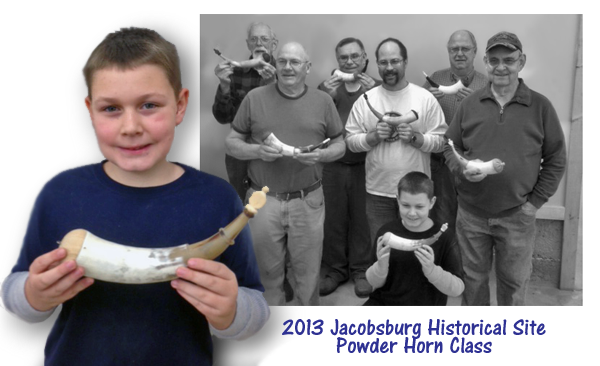
11 Year Old Tristan Frigm files a horn at Jacobsburg. Photo: Dave Ehrig

Last March, at the annual HCH Conference, the Executive Committee voted to support a request from the Jacobsburg Historical Society (JHS) for funds to renovate a section of their barn complex. This project is to create space for their expanding Early American Craft program. A donation of $2500.00 was approved and a previous donation of $500.00 was to be applied as well. For many years, JHS has offered a rifle building class. The classes soon reached their maximum and are now offered twice a year to accommodate the volume of students. Three years ago, the HCH offered to teach and sponsor a horn class as part of the JHS craft program. The powder horn class is now at full capacity. Last year a leather class was added and due to the lack of space, it is held at a remote location. The Board of Directors at JHS realized that additional space was needed. The barn complex (used for storage) was the least expensive and most logical choice. Support was sought from the CLA, KRA, HCH, Embassy Bank, Northhampton County and several private donations, all graciously supported the renovation project. Three rooms are involved. One will be a 20’X 24’ space for the classes. Another room will be a bathroom and tool and storage area. The third will be a utility room. The permit process is now underway and it is hoped that construction will start this fall. Many of our guild members are familiar with Jacobsburg which is now the location of our annual summer picnic. The event is held in the garden of the J.J. Henry Mansion. Our members are offered tours of the house as well as a visit to the Pennsylvania Longrifle Museum and the Nicholas Hawk gun shop. This is the site of the Bolton Gun Works that was built in 1812 by the Henry family. Today it is 30+ acres of beautiful, rural Pennsylvania. Our summer picnic takes place the Friday evening of Dixon’s Gun Makers Fair which is only 45 min. away. Our summer event is a great opportunity for the members, their friends and families to gather together and socialize. For more information about the Jacobsburg Historical Society, visit www.jacobsburg.org. Sincerely, Frank Willis JM

Scott Morrison at the 2010 HCH Dinner at Jacobsburg.

The Barn Complex at Jacobsburg.


Easy to Make Sterling Silver Powder Horn Butt

HCH member Tim Johnson shares how he created this stunning Sterling Silver butt on his New York F&I map horn in the short article below. If you have any questions, please use the comment form below the article. Thanks.

“Powder Horns: Fabrication & Decoration” a book review

Jim Stevens is a member of the Honourable Company of Horners and an author. Stevens wrote Powder Horns: Fabrication & Decoration. I asked Stevens if I could review the book and he sent me a loaner copy very quickly. My assessment of the book follows and I hope you enjoy it. By the way, the HCH’s publication, The Horn Book, will have a more detailed article about Jim Stevens in the next issue. Thanks for reading, Rick Sheets HCH Webmaster
Powder Horns: Fabrication & Decoration Author: Jim Stevens Schiffer Publishing Size:  8 1/2″ x 11″ Illustrations:  275 color photos Pages:  176 Binding: Soft Cover First of all, I want to thank Jim Stevens for allowing me to review his book. The book is thoughtfully laid out in six chapters, from horn basics through how to strap the horn for carrying. You can start with a fresh horn or hull, learn to turn it into a powder horn, embellish it and then finish with a finger woven strap.  Stevens’ book does not gloss over anything. Something I look for in a “how to” book is appropriate illustrations or photographs. Stevens’ book has 275 of them. Stevens’ writing is clear and concise. He picked a clean, modern type face and size that makes the book easy to read. Chapter 4 was most interesting for me. Stevens takes the reader through the decorating process. Stevens illustrates the time-tested scrimshaw techniques for the purist. And then how to use technology to help get the image you want on your horn. The option of using modern transfer techniques is very nice if you have a complex image to reproduce or if you are challenged in drawing. So do it old-school or new-school; it is up to you. I would like to point out that the book has what I consider a bonus; you will find a whole chapter on how to weave a strap using several different methods. Using the clear instructions in this book removes any excuse you have for making a nice horn and then strapping it badly! After reading Powder Horns: Fabrication & Decoration, I can truthfully say, “Pick-up the book, then buy your horn and tools.” You will save a few false starts and a wasted horn or two. >>Buy the book from Schiffer Publications from this link.<< -Rick Sheets
PS: Please note that Jim Stevens will be giving: Scrimshaw Instruction June 6 – June 10, 2011 at The NRA Gunsmithing School Trinidad State Junior College (Trinidad, CO) Follow this link for more information. www.scrimshawstudio.com/tsjc.html

Search for the Ackley Horn

We had an unusual request from Mark Ackley, who is a family historian. He needs help to find an heirloom that was sold at auction.  The details of the powder horn in question are sketchy and the only known photographs of the horn are not the best. What we can see is a nice, right side horn with a cityscape engraving at the top. The horn has little twist and the low dome butt is held with domed tacks. There is additional engraving on the horn, but one cannot tell much from the photos. If you know the whereabouts of this horn, please use the form below. Regards, Rick Sheets HCH Webmaster

“My name is Mark Ackley. It is my intention to search for this powder horn and re-unite it with my family once again if possible. It has a story. The powder horn belonged to Daniel Ackley. Daniel was born in 1760, presumably in Little Egg Harbor, NJ. Daniel did serve in the Gloucester County Militia during the Revolutionary War serving in Captain James William’s Company of the New Jersey Militia. The horn was passed to one of his sons, Joshua Ackley who left it, eventually, to his granddaughter Elizabeth “Lucille” (Ackley) Evans Carroll. It is her hands that hold the horn in the picture. Unfortunately the powder horn was sold at a West Finley, PA estate auction in 1991; it has not been seen by the family since. Of note is that Daniel’s son, Joshua was responsible for building the “Ackley Covered Bridge” in 1832. The bridge was donated in 1937 by Lucille to Henry Ford and Thomas Edison for display at Greenfield Village in Dearborn, Michigan where it can be seen today.” If you know where this horn is, please use the form below.

The Spring Pole Lathe Project – Update March 12, 2011 – Nearing Completion

Left to right. Ed Long, Guildmaster, Dick Toone, lathe builder and Rowland Cadle, Master Horner and Founder.

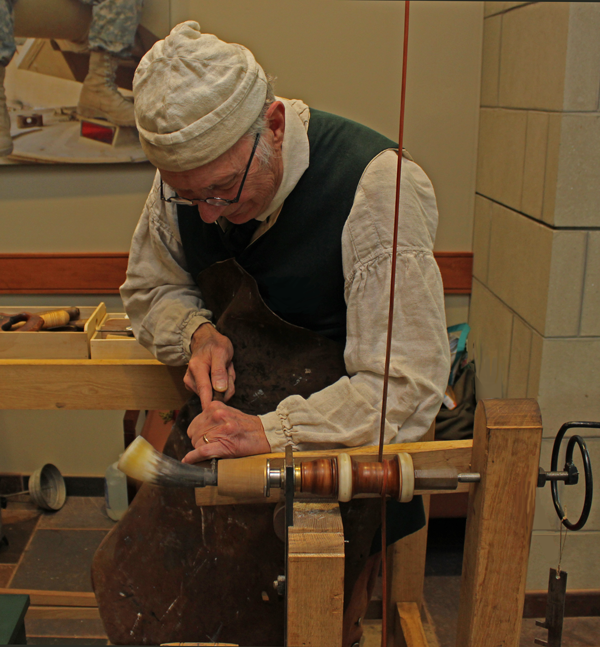
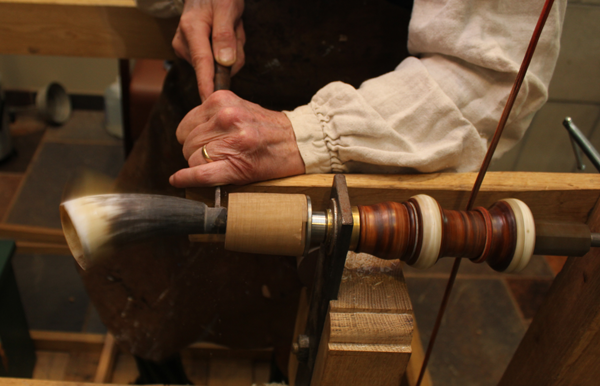
Dick Toone, project leader of the spring pole lathe project, displayed the lathe at the HCH’s Fifteenth Annual Meeting at Fort Roberdeau. It was very close to completion. Once it is complete the lathe will enable the user to turn all of the parts for a screw-tip horn using only human power much the way it was done in the 18th and the early 19th Centuries.

Dick Toone is sawing out the slot for the boom to pivot on with best tool for the job, an original bow saw.

Temporary Mandrel

Here is the the temporary mandrel (with the rope around it) supported on a fixed center point at right and the bearing end in a temporary support of wood. When finished the mandrel will be made with a short piece of octagonal rifle barrel with a brass bearing on the end to the left and a wooden spool where the rope will turn it. The rifle barrel end protruding from the bearing will have coarse external threads that various fixtures (face plates) will thread on to to hold screw tip horn parts for turning. Also shown is a mandrel with a fixed drill bit installed made by Erv Tschanz. Several fixed tool mandrels will be employed to do various functions in the manufacture of a screw tip horn.

The next installment will show the finished Portable 18th Century Spring Pole Lathe.

By the way, I urge you to go to Dick Toone’s website, Living History Shop, to view his museum quality 18th Century reproductions.

Regards, Rick Sheets HCH Webmaster

The Spring Pole Lathe Project – Update Feb. 28, 2011

It is one thing to buy a plan from a trusted source for a gizmo that has been proven to work. It is a whole new ball game to take an idea for a machine and use period building techniques and years of experience to draw-out your own plan. This is what Dick Toone does and then he builds it. I have asked Mr. Toone to keep us abreast on the Spring Pole Lathe Project. Mr. Toone believes it will be ready to use at Ft. Roberdeau. Here is a little teaser on some on the building in process in Mr. Toone’s own words. Thanks Dick for keeping us informed. Best regards, Rick Sheets HCH Webmaster

Spring Pole Lathe - White Oak Uprights

The approximate 3 X 3 post is being relieved 1/2″ to receive one of the two lathe bed rails after the 14 degree dove tail is cut in to match the already cut dovetail on the rail end.  This joining will be glued and pegged for permanent fastening.

Spring Pole Late - Posts

Here is a plank cross-section of 3″ rough-sawn white oak used to make upright posts.  White oak is much more dense and heavy than red oak and was selected for equipment framing like a lathe or printing press, and used extensively in ship building and horse drawn equipment.

Spring Pole Lathe - Joinery

The posts are now all machined and have mortise holes cut to receive cross beams and rails.  The post shown laying over is connected by a “rule joint” that when upright will have a horizontal light weight beam that transfers up and down foot motion from a treadle via rope to the drive mandrel of the lathe, then to one of the light weight beam ends, the other end of which connects to the spring poles at the base of the frame by another piece of rope.  Sounds complicated, but the picture shows the simplicity.  The “rule” joint is an all wooden hinge design with an iron pivot pin.
I will send more photos next week. Dick

Spring Pole Lathe Project Update – We Need Lathe Tools

To be able to demonstrate the Spring Pole Lathe tools will be needed. In particular the following would be basic: (2) Faceplates 3 or 4 inch diameter internal threaded 3/4-16TPI.  Turning tools about 16 inches long: (1) 1/2 inch skew chisel, 1 inch same, 3/8 inch Spindle gouge, 5/8 inch same. (1) 1/2 inch Spear point, (1) 1/2 inch Round Nose Scraper, (1) 1/4 inch Parting Tool, and (1) 3/8 inch Hollowing Tool.

Dick Tonne with some of his wares.

To ensure a better 18th Century presentation, these tools can all be used (not new) and do not have to match.  It would be preferable thay not be shiny chrome for the 18th Century theme. The tools will be stored on a special chest to go with the lathe along with other necessary tools and accessories.  The supply of the tools will be a way for members to participate in the Lathe project. Please bring the tools to the 2011 Annual Meeting now being held at Ft. Roberdeau in Altoona, Pennsylvania. Regards, Dick Toone Project Leader

Col. Carl Dumke, USAF an Emerging Horner

Carl Dumke with a sign and horns of his making.

Col. Carl Dumke, USAF is a twenty-two year career military man stationed in Williamsburg, Virginia. Dumke comes from a military family going back to the birth of our nation. He is married to Jennifer a member of the Daughters of the American Revolution and a self-described “horn widow.” Dumke has three children; their ages are twenty-two, eighteen and twenty years of age. Dumke is also a folk artist, who creates one-of-a-kind trade signs in 18th century style. One would think that this avocation would satisfy his artistic needs, but not so. While visiting with Jim Leach, who is a Journeyman Saddler with the Colonial Williamsburg Foundation and long-time horner and HCH member, Dumke was exposed to horn work .  Jim’s wife asked Dumke if he was a “horner.” Dumke said, “A what?” Dumke soon found out what a horner is.  After viewing Jim Leach’s work, Dumke was hooked. Two and a half years and tweny-five horns later, with a class with Roland Cadle under his belt and advice from horners like Art DeCamp , Carl Dumke is emerging as a horner whose work is artistic and authentic. Dumke likes horns that are not overly sophisticated; the ones he imagines were made by military men during an engagement. Dumke believes many F&I War horns are commemorative pieces made by paid horners after the military action and he prefers the horns with a more primitive feel. Dumke started out making Revolutionary War and F&I War styled horns to honor the Patriots in his family tree and hunting horns for his non-military ancestors. Dumke toys with the idea of creating his own horn to commemorate his tour in Afghanistan. We at the Honourable Company of Horners thank Col. Dumke for his service to our country and look forward to seeing his own campaign horn!
Carl Dumke does take on commissions for trade signs on occasion. You may reach him through his email address, which is cdumke99@aol.com.
The Jonathan Bagley Horn (by Carl Dumke) Dumke identifies with Col. Bagley and wanted to make a horn to honor Bagley’s engagement against the Iroquois and French at Fort William Henry. Here is a series of photos of a campaign horn in period style inspired by the horner John Bush. (The pictures are lightened to show the detail of the horn.)